Introduction - Why? -- Pictures - Videos & Time-Lapse - Sailors' comments - Learning Points - Further info Please ask!..
The 3rd UK Morbic Capsize Party. 9th November at Reading Sailing Club
We believe the current active Morbic English Fleet is 12, of which four attended this year. Half a dozen more are inactive, "status unknown", or not actually in England.
An extremely valuable and potentially life-saving exercise . We again learned important lessons. Some crews have already stated they will be back for more!
(The 2024 capsize party page includes; Why? - The Ladder - Pictures and videos - What we've learned, Methods, Comments and analysis - Links to capsizes on other websites)
WHY DO WE DO IT? - Morbics rarely capsize.
Experience shows righting a capsized Morbic can be relatively easy - but RE-BOARDING a Morbic can be CHALLENGING ! !
How do we know? - We've done it, watched others doing it, and studied videos.
PICTURES (click to enlarge) and VIDEOS
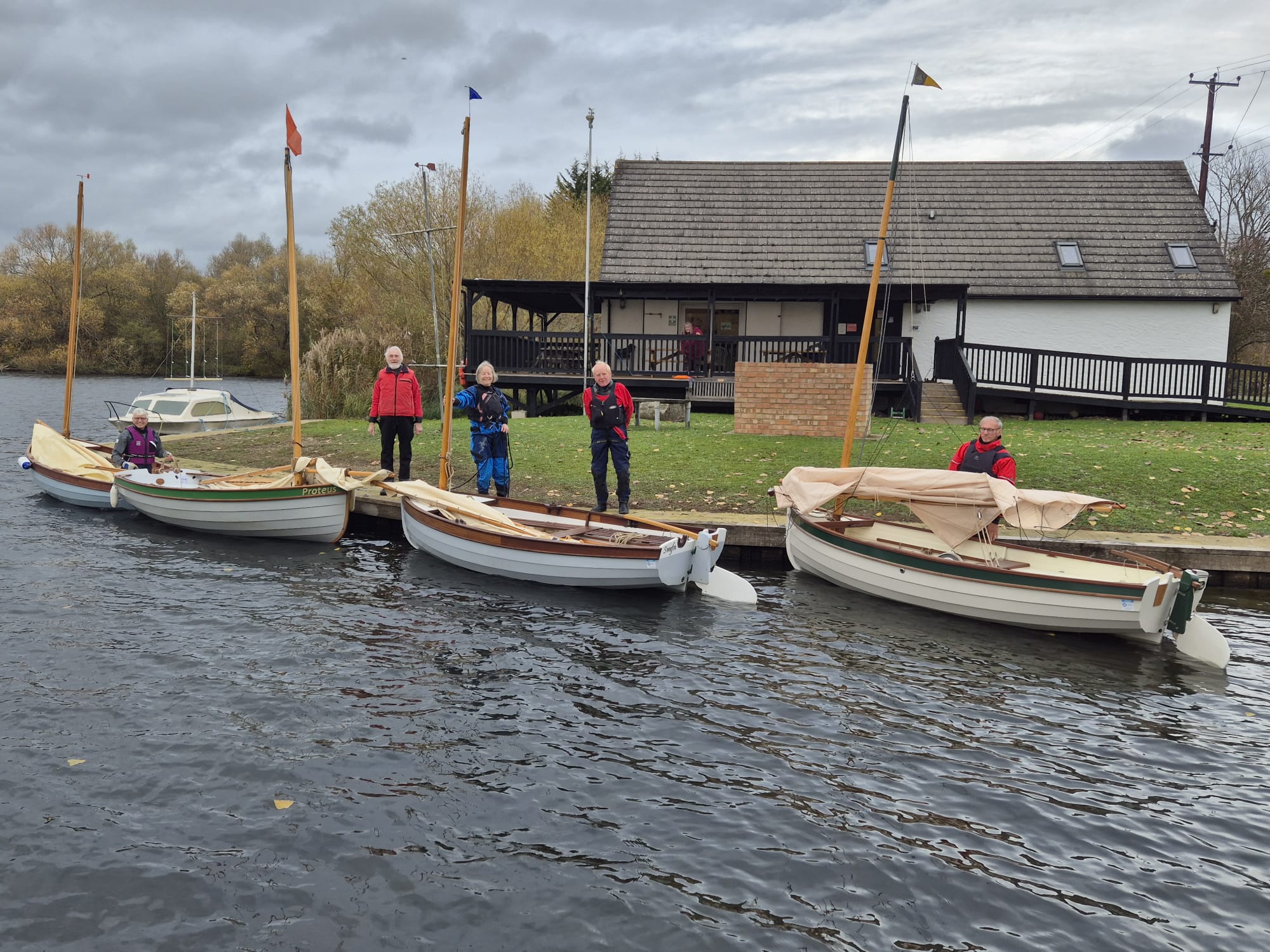
Four Morbics in front of RSC clubhouse.
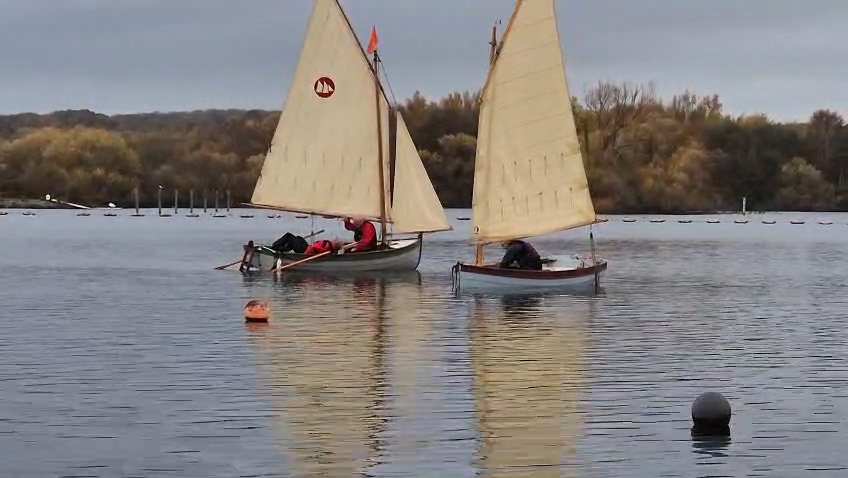
Morbics cruising / drifting.
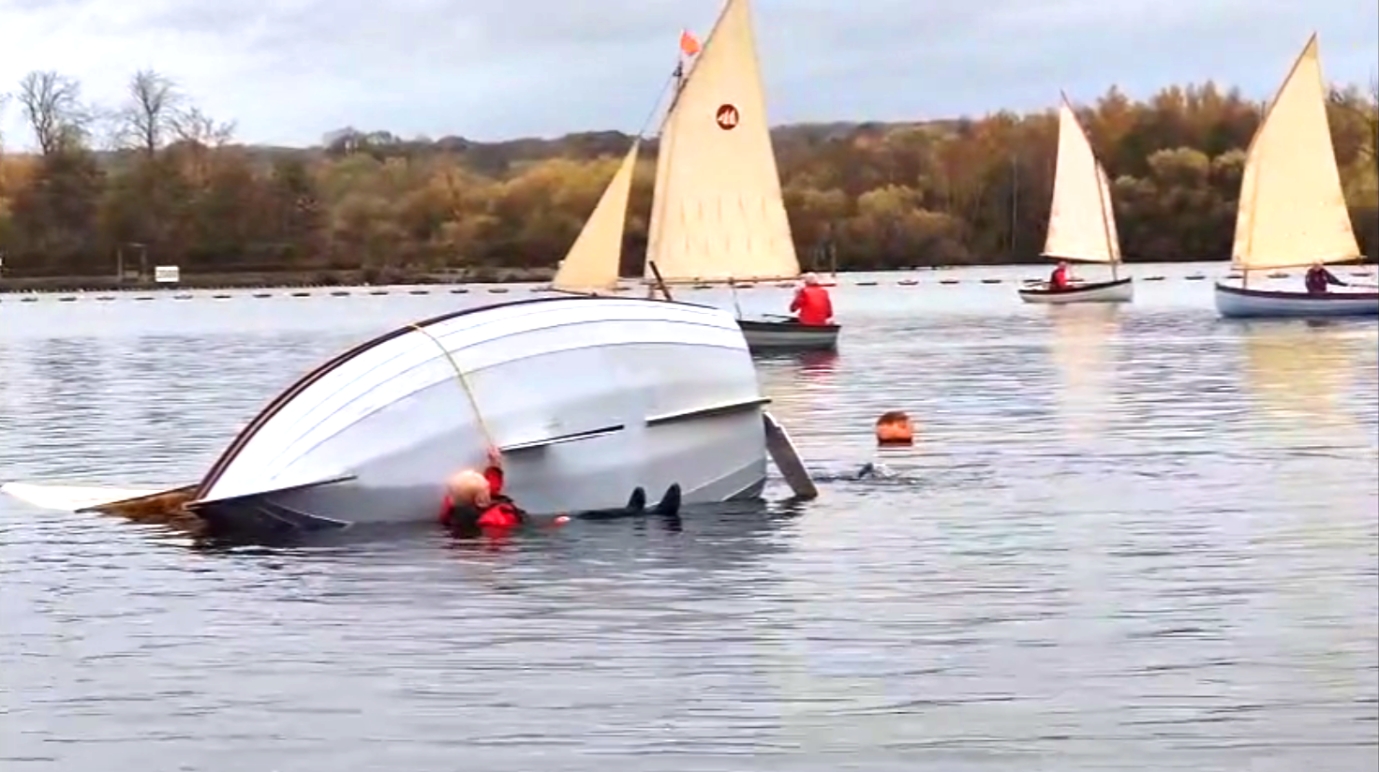
Four Morbics on RSC lake
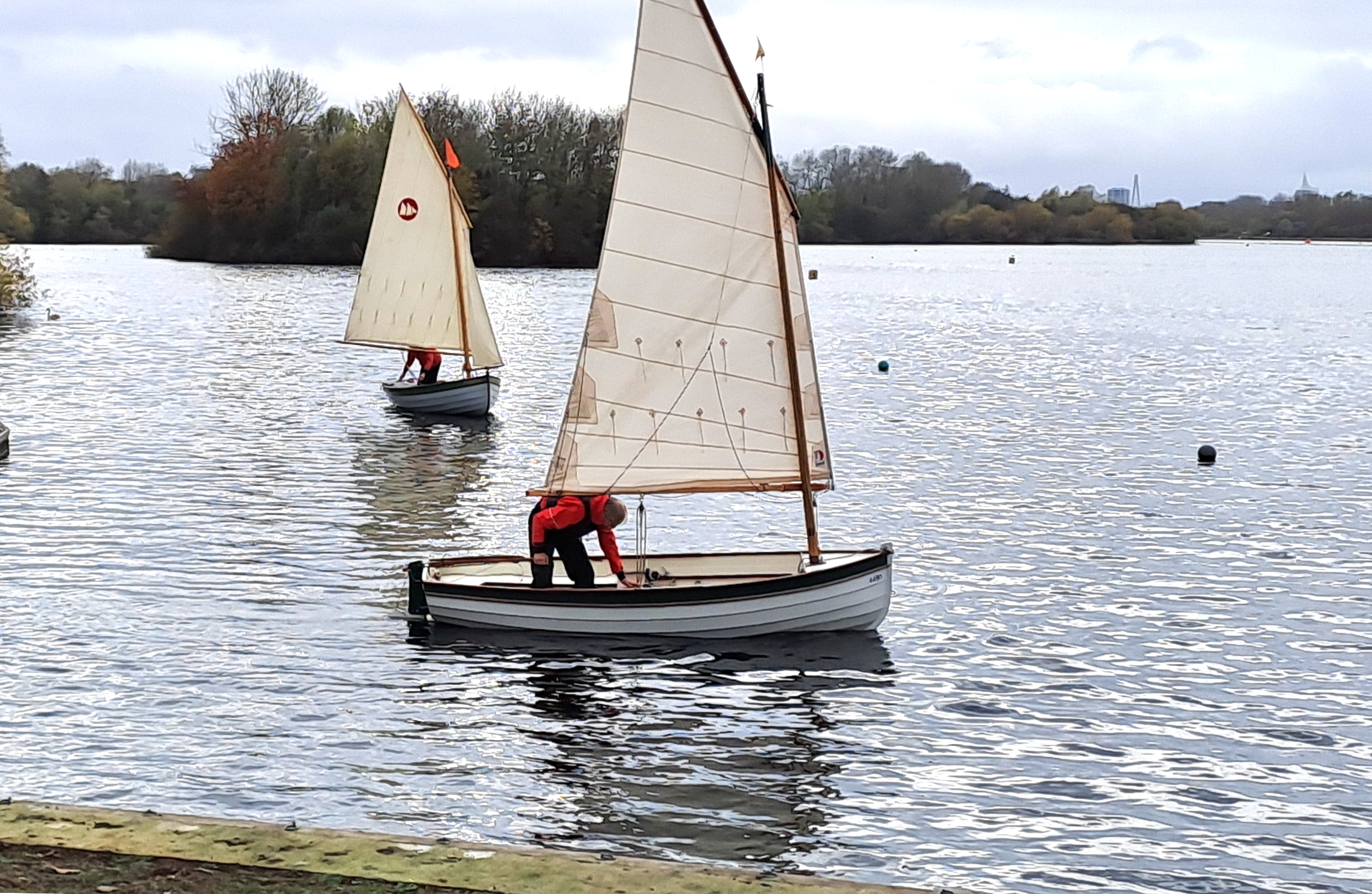
Morbics sailing (almost)
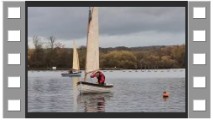
MW's attempted capsize (had water ballast). Attempted re-boarding. Is his ladder too short? Re-boarded with PW's.
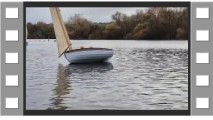
SC & MC's capsize and attempted re-boadring. SC was scooped up. MC re-boarded with PW's ladder.
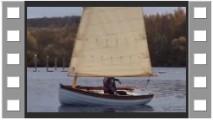
PT's double capsize then re-boarding over the side
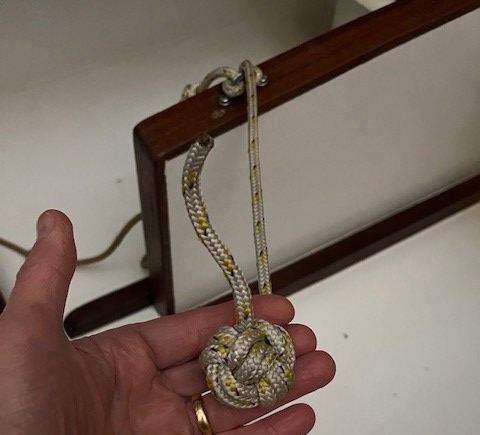
PT's grab line
PW's Dry Capsize
PW's Capsize. Abbreviated Version 1:17
PW's Time-lapse shows simple use of righting lin
Full length Version. PW's capsize. Snagged righting line later used with ease. Re-boarded OK.
MC & SC’s capsize - Sailors' comments
MC can right the boat using a righting line to lift his weight out of the water with both legs over the centre board (in calm conditions).
SC cannot right the boat. Neither of us can now re-board with the existing rope ladder.
The boat can drift faster than MC can swim.
We both wear waterproof VHF (set to 16 and nearest harbour master) and a flashing electronic flare.
Crutch straps now fitted to our buoyancy aids prevent them riding up.
Times
Capsize to righted = 04:26 . Lost time; Righting = 1:54, MC boarding = 2 mins or more, Total lost = 4 mins or more.
i.e. Could achieve 01:26 or better with improved righting technique, alternative righting line stowage, and better ladder.
PT’s capsize - Sailor's comments
The short, weighted, knotted rope secured at the back of the centreboard case enabled me to pull myself into the boat over the side, after righting, with relative ease.
Not sure how to avoid pulling the boat back on top of me - maybe try to make use of any wind blowing and enter from the windward side.
Times
Capsize till ready to bail = 02:15 . Time lost, about 1 min due to 2nd capsize.
i.e. Could achieve 01:15 or better if no 2nd capsize.
MW’s capsize - Sailor's comments
Unable to capsize my Morbic (had water ballast) by sitting on the side or standing on the side, even leaning full body weight out on the boom.
Recovery stirrup (ladder?) fitted at transom. Got one foot in the stirrup but couldn't pull myself upright enough to swing a leg into the boat, even by using centre mooring lines to assist.
Managed climb into PWs boat using his ladder.
To facilitate re-boarding - A steel stirrup with additional step, braced against mounting bracket when deployed so it does not pivot under hull.
A heavy knotted rope with a very strong fitting to pull your-self up straight & give support as you step over the transom.
Air in the dry suit impedes mobility.
Times
Time lost; Attempted re-boarding at ladder = 1:03; Attempted re-boarding at side = 15 secs or more.
Jumping in to access the ladder = 12 sec.
Suppose deploying latter & boarding takes 1:00 . M.o.B to inboard could achieve = 1:12 or less if the upright boat doesn’t sail away from you.
PW’s capsize - Sailor's comments
Time wasted with poorly stowed righting line and attempted raising with weight on c-plate.
Mk2 Ladder - Stowage, Deploying, ease of use - all OK. Some strengthening and other mods required.
Times
Capsize to re-boarded = 3:36
Time lost while not using righting-line = 1:00. i.e. should achieve 2:26 or less with better-placed righting line.
De-powering -
* A boat (especially with rig up) can drift faster than you can swim. Should we release main halyard (& jib if present) before attempting righting? This would de-power and allow rig to fall to deck as the boat comes upright. This reduces risk of boat sailing away from overboard crew.
Wear waterproof VHF (set to 16 and nearest harbour master) and a flashing flare.
Keep hold of the boat. Swimming backwards you lose sight and contact with the boat.
Righting -
* SC & MC rely upon crew to throw the righting line over the hull. This is likely to be into wind which could be impossible? (No wind on practice day).
* Should we adopt righting line (which doubles as breast mooring line) routed from frame 3 (amidships), along outside between the rubbing strips, to a release device at transom, i.e. accessible when swimming around the stern. (PW's was experimental, not well placed, and got fouled by the tiller.)
* Righting lines (secured as above) seem to work best if used aft of the C-plate; place knees against hull, then feet. The righting-leverage is better at that location. (See Time-lapse video)
* Do test to compare using righting line forward Vs aft of the c-plate.
Some sailors succeed righting by leaning on c-plate.
A righting-line would work even if C-plate retracted or broke. See PW's capsize
Re-boarding -
Rope ladders and strops - AVOID – They tend to swing away under the hull.
* A rigid ladder with off-stand to provide user-friendly angle seems best for most sailors. Depth of bottom step must be sufficient to allow for possible reduced agility. (i.e. maybe lower than current versions.)
* If there are two sailors - One can be scooped up. Should then deploy ladder before bailing.
* Sit in stern to begin bailing (Weight in stern is stable; in bow is unstable. Plus brings stern down for other crew to board).
* Without ladder - Boarding over the side may be easy if you're light and agile. Near bow risks 2nd capsize. Near stern is more stable.
* PT’s grab line could be useful with/without ladder. (See pic)
Water ballast -
Pros = Increased stability = Less lively = reduced risk of MoB?
Cons = Increased stiffness. Is this desirable? Increases risk of dismasting? Speed reduced by less optimal waterline Vs effective beam?
It has been suggested that "a small crew member/passenger would also cause all of the above". - What's your opinion?
Misc –
PFDs must have crutch straps to prevent them riding up.
Dry-suits - Get a buddy to do up your zips, or at least check them.
“Burp” suit periodically during sailing?
Next year -
Do it in Sept/Oct, (before GMT, for longer daylight). Do it in the morning?
* Test why a Morbic almost turtled in 2024.
* Review items asterisked above for testing.*
See 2024 capsize party page for what we learned last year. + Pics and videos + PW's Mk1 boarding ladder.